Itemized quotes, the difference between VAT-inclusive and VAT-exclusive prices, quotes with options, site visit fees and validity periods, plus a short note on the 2026–2027 e-Archive invoice rules.
A good price quote answers the customer's question: "What exactly am I paying for?" A clear, itemized quote that states its VAT treatment both raises your chances of approval and prevents disputes once the job is done. This guide is for service providers working in home services and appointment-based trades.
1. Split the items: labour, materials, other
For each item, write a description, quantity, unit and unit price. Choose units that fit the nature of the work: m² for painting, hours or pieces for plumbing, per job for moving. Separating labour from materials makes it easier for the customer to decide based on material quality.
2. Is VAT included or excluded?
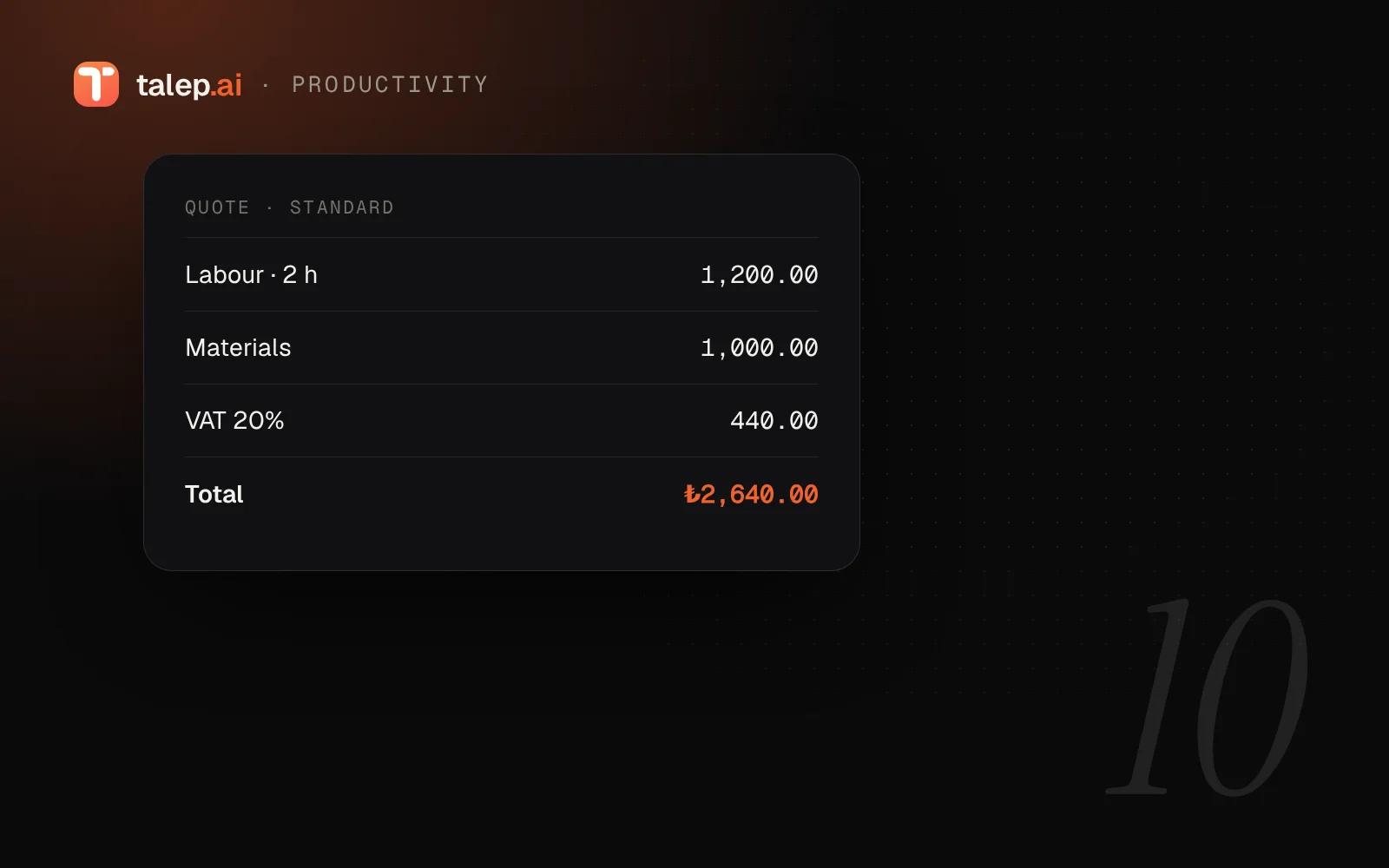
This is the most common misunderstanding. State clearly in your quote whether prices include or exclude VAT (KDV), and always show the grand total including VAT. The calculation is simple:
- If you entered prices excluding VAT: VAT = net amount × rate / 100; total = net + VAT. Example: ₺1,000 + 20% VAT = ₺1,200.
- If you entered prices including VAT: net = total × 100 / (100 + rate); VAT = total − net. Example: ₺1,200 (incl. 20% VAT) = ₺1,000 net + ₺200 VAT.
Which rate applies to your work depends on your line of business; if you're unsure, ask your accountant (mali müşavir). In the talep.ai quote tool you choose one of the 0%, 1%, 10% and 20% rates, and the system calculates the net amount, VAT and total per line item.
3. Offer options
If the same job can be done with different materials and scope, offer three options: Economy, Standard, Premium. When customers can compare, they decide faster, and you end up discussing scope rather than haggling over price. On talep.ai you can send up to three options in a single quote; the customer picks one and accepts it in the app.
4. A site visit first, if needed
Pricing a job without seeing it either inflates the quote unnecessarily or leads to price changes later. If a site visit is needed, propose it clearly: is it free or for a fixed fee? Offering a few time slots speeds up the booking.
5. Validity period and revisions
Because material prices can change, give your quote a validity period (for example, 7 days). If the scope changes, send a new version; keeping the previous version in the history rather than deleting it keeps things transparent. On talep.ai validity can be set between 1 and 90 days, and if the customer doesn't respond within 24 hours they get one reminder.
6. Make good use of the notes field
Warranty terms, payment method, the estimated duration of the job and anything the customer needs to prepare (for example, moving furniture out of the way) belong in the notes field. Short, bulleted notes get read more than long paragraphs.
A quote is not an invoice: a note on e-Archive
A price quote is not an invoice; once the job is completed, you must issue the invoice in line with Turkish tax legislation. Under the amendment made to General Communiqué No. 509 by the Revenue Administration's (GİB) Tax Procedure Law General Communiqué No. 589 (589 Sıra No.lu VUK Genel Tebliği, Resmî Gazete, 31.12.2025):
- Taxpayers keeping balance-sheet-basis books issue all their invoices as e-Archive invoices from 1 January 2026, regardless of the amount.
- Taxpayers under the simplified method or keeping operating-account-basis books may issue paper invoices until 31 December 2026 for amounts not exceeding ₺3,000 including taxes; invoices above this amount are issued as e-Archive invoices.
- From 1 January 2027, all invoices, including those of simplified-method and operating-account taxpayers, are issued as e-Archive invoices regardless of the amount.
Sources: Revenue Administration (Gelir İdaresi Başkanlığı), VUK General Communiqué No. 509 (509 Sıra No.lu VUK Genel Tebliği, current consolidated text), and the TÜRMOB announcement dated 02.01.2026. Confirm how this applies to you with your accountant.
Quick quote checklist
- Are the items, quantities and units correct?
- Are the VAT rate and "included/excluded" clearly stated?
- Are options defined (if needed)?
- Are the site visit fee and times specified?
- Is there a validity period?
- Do the notes cover warranty and payment method?
On talep.ai, all of these steps are ready in the quote tool; the system calculates the totals and the customer accepts in the app.